
Home › Fish and seafood
Fish and seafood
Big landing? Freeze it the same day.
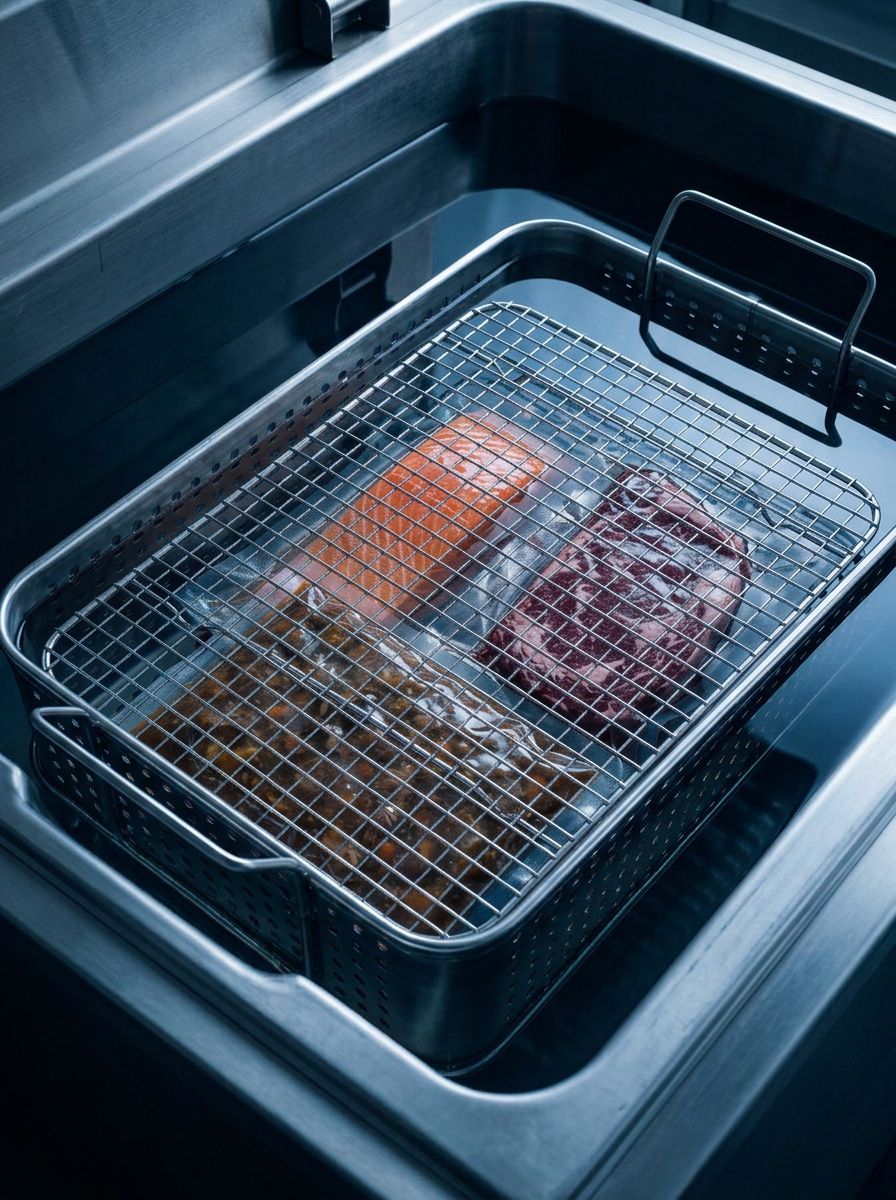
Fish, scallops, shrimp: your vacuum-packed products freeze in minutes, straight off the processing line. What can't be sold fresh is saved, not thrown out.
The situation
With seafood, every hour counts.
Short seasons, big landings
Everything comes in at once. You have to process and freeze fast, before quality drops.
Freshness fades fast
Every hour before freezing counts. Slow freezing means lost juice and texture when thawed.
What can't sell fresh is lost
A landing too big to sell fresh means downgraded or discarded product, for lack of fast freezing on site.
What you can freeze
Your seafood, once it's vacuum-packed.
- Fish fillets and portions
- Scallops and shrimp in pouches
- Lobster and crab meat
- Smoked or marinated fish
- Value-added products and prepared dishes
- Surplus from a landing, frozen instead of lost
One condition: a sealed vacuum pouch. The product never touches the bath liquid.
In your production
One more step on your line, not a construction project.
Vacuum-pack
As you do today, or with a sealer upstream.
Lower into the cold bath
The Unit S cools its bath with electricity. No gas to order.
Store or ship
Product comes out frozen, ready to go the same day.
- Recommended setup
- One Unit S, plus the Container in seasonThe Container, planned for 2028, is rented for the length of your season.
- Target capacity
- ≈ 20 kg/h per unitAbout 150 kg per 8-hour shift, depending on product and thickness.
- Power
- 240 V single-phase, one dedicated circuit
- Footprint
- ≈ 1.3 × 0.7 m, on castersThe space of a chest freezer.
- Build
- Stainless steel tank, fully drainable, easy to clean
- Tracking
- Cryo Connect: every batch logged, with traceability and alerts
Target specifications, to be confirmed on the prototype.
Compare
Blast freezer, nitrogen or immersion?
Blast freezer
Easy to plug in. But air pulls heat out more slowly than a liquid. As volume grows, you need several cabinets.
Liquid nitrogen
Very fast. But it needs a tank, ventilation, oxygen monitoring and nitrogen deliveries.
Immersion · Unit S
Fast, on a 240 V plug, nothing to order. Its limit: the product must be vacuum-packed.
Order of magnitude for a 2.5 cm vacuum-packed portion, from +4 °C to −18 °C at the core: about 1 hour in a blast cabinet, about 15 minutes by immersion. These are not our measurements yet: those will come from the prototype.
We're looking for pilot plants for 2027
Do your landings outrun your freezing capacity? We want to test the Unit S with your products, on site.
Put my plant forwardAlso for
FAQ
Questions seafood processors ask.
Can loose shrimp or scallops be frozen?
No: with the Unit S, the product must be in a sealed vacuum pouch. For loose product, a nitrogen or blast tunnel is a better fit.
Does the bath liquid touch the fish?
No. Only the pouch is in contact with the bath. The liquid is non-flammable and registered NSF HT1 for incidental food contact.
Where does the Unit S go?
Indoors, in your facility: it needs one dedicated 240 V single-phase circuit and some clearance for ventilation. It sits on casters and takes the space of a chest freezer.
What about peak season?
Line up several units, or rent the Plug & Play Container, planned for 2028: four Unit S machines, a packing station and a sink, delivered and taken back after the season.
Can we test before buying?
Yes. Trials run in 2027, and we are signing up pilot sites now. Write to us with your products and volumes.
Contact
Let's talk about your production.
Thirty minutes to understand your volumes, your products and your season. No commitment.
- Arnaud de Kettenis, founder
- Montréal, Québec
- linkedin.com/in/arnaud-de-kettenis