
Home › Food hubs and shared facilities
Food hubs and shared facilities
One freezing system, many businesses.
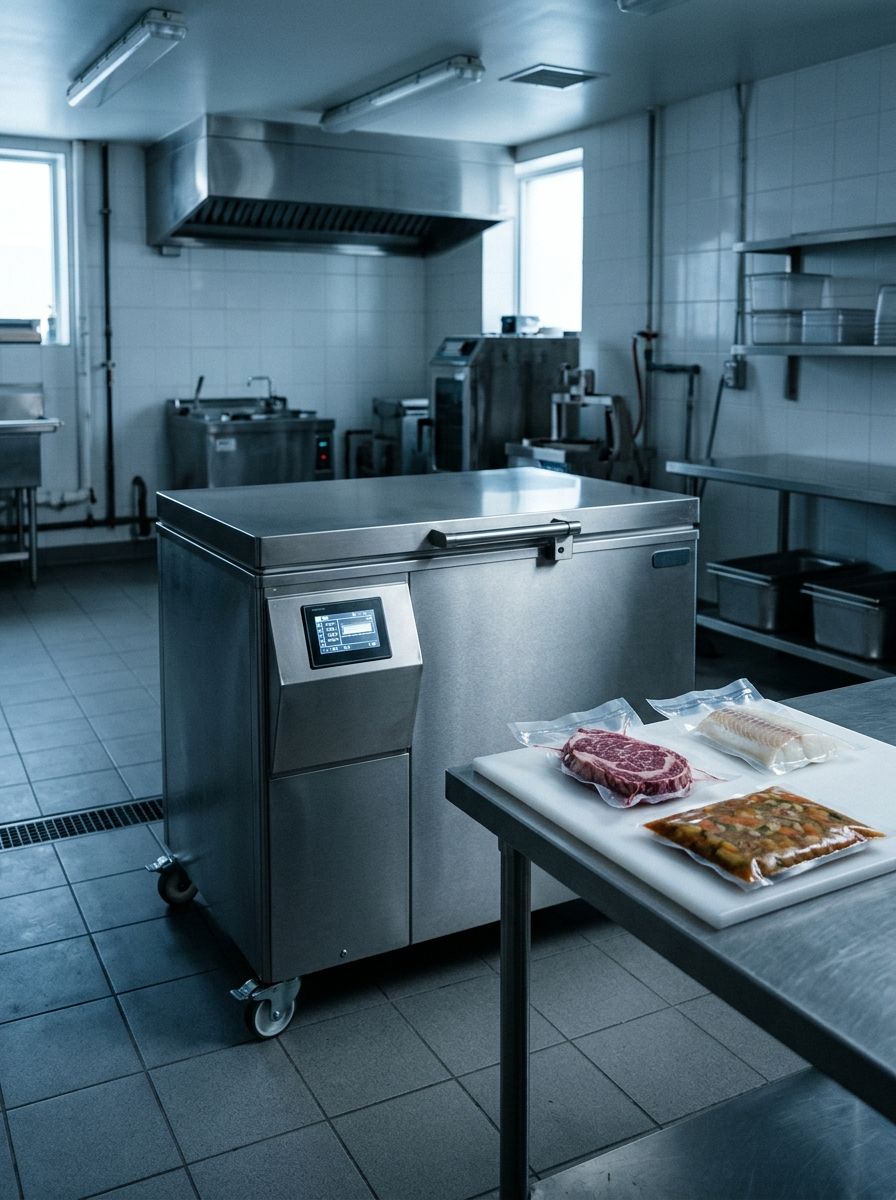
In a food hub or shared facility, each member freezes its vacuum-packed products in minutes. One machine, one 240 V plug, and less surplus lost.
The situation
The need for fast freezing is shared. The equipment can be too.
Members lack fast freezing
Not everyone can afford a blast freezer or a tunnel. The need is common.
Surplus is lost at every member
End of batches, unsold product, trials: without fast freezing, each member throws a little away. Together, it adds up.
Space is tight
In a shared facility, every square metre counts. No room for heavy installations.
What your members can freeze
Every member's products, vacuum-packed.
- Meat, fish, prepared meals and sauces
- Small batches from several businesses, back to back
- Surplus and unsold product, saved from waste
- Seasonal production
- New product trials
- Group orders before a trade show or holiday
One condition: a sealed vacuum pouch. The product never touches the bath liquid.
In your production
One more step on your line, not a construction project.
Vacuum-pack
As you do today, or with a sealer upstream.
Lower into the cold bath
The Unit S cools its bath with electricity. No gas to order.
Store or ship
Product comes out frozen, ready to go the same day.
- Recommended setup
- Several Unit S, or the ContainerBought by the hub and shared among members.
- Target capacity
- ≈ 20 kg/h per unitAbout 150 kg per 8-hour shift, depending on product and thickness.
- Power
- 240 V single-phase, one dedicated circuit
- Footprint
- ≈ 1.3 × 0.7 m, on castersThe space of a chest freezer.
- Build
- Stainless steel tank, fully drainable, easy to clean
- Tracking
- Cryo Connect: every batch logged, with traceability and alerts
Target specifications, to be confirmed on the prototype.
Compare
Blast freezer, nitrogen or immersion?
Blast freezer
Easy to plug in. But air pulls heat out more slowly than a liquid. As volume grows, you need several cabinets.
Liquid nitrogen
Very fast. But it needs a tank, ventilation, oxygen monitoring and nitrogen deliveries.
Immersion · Unit S
Fast, on a 240 V plug, nothing to order. Its limit: the product must be vacuum-packed.
Order of magnitude for a 2.5 cm vacuum-packed portion, from +4 °C to −18 °C at the core: about 1 hour in a blast cabinet, about 15 minutes by immersion. These are not our measurements yet: those will come from the prototype.
We're preparing trials with hubs in 2027
Trials are planned with the member businesses of a Montréal agri-food hub. Your hub could be next.
Put my hub forwardAlso for
FAQ
Questions food hubs and shared facilities ask.
How is the equipment shared among members?
Cryo Connect logs every batch, with traceability and alerts. The hub keeps a history of every use.
Does one member's product touch another's?
No. Each product stays in its vacuum pouch and never touches the liquid. Only the pouch is in contact with the bath.
Who buys the equipment?
Usually the hub, which shares it among its members. The Unit S can be bought or leased; the Container can also be bought for hubs.
Does it help reduce food waste?
That's one of the goals: surplus frozen the same day is kept instead of thrown out. Cryo Connect tracks the volumes frozen.
Can we test before buying?
Yes. Trials run in 2027, and we are signing up pilot sites now. Write to us with your products and volumes.
Contact
Let's talk about your production.
Thirty minutes to understand your volumes, your products and your season. No commitment.
- Arnaud de Kettenis, founder
- Montréal, Québec
- linkedin.com/in/arnaud-de-kettenis