
Home › Food waste
Food waste
What you freeze today, you don't throw out tomorrow.
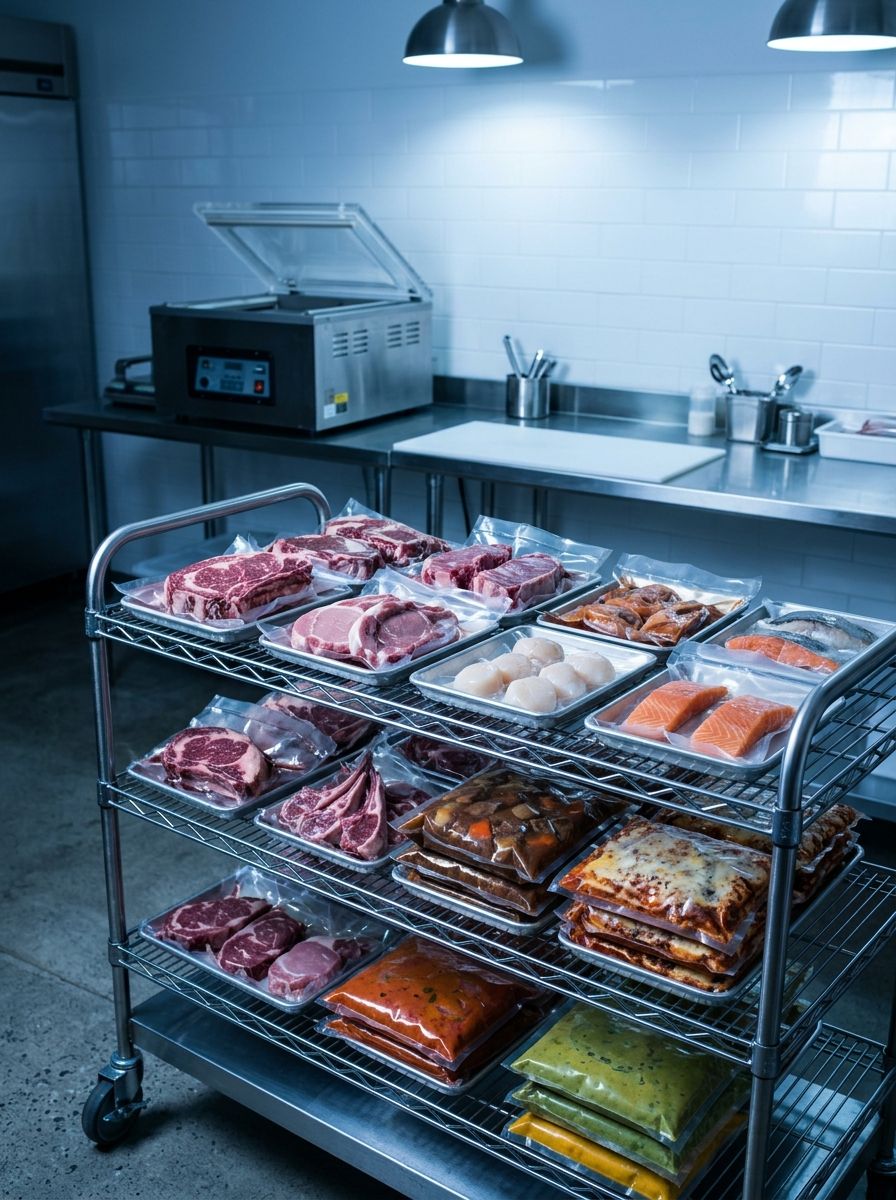
Production surplus, end of season, unsold product: vacuum-packed, it freezes in minutes, the same day. Fast freezing buys your products time, and a second chance to sell.
The numbers
Much of the food we produce is never eaten.
of food in Canada is wasted.
of that waste could be avoided.
of food lost or wasted during processing and manufacturing, worth nearly $21 billion.
Sources: Second Harvest, The Avoidable Crisis of Food Waste: Update, 2024, for the first two figures. Second Harvest and Value Chain Management International, The Avoidable Crisis of Food Waste, 2019, for the third.
Where fast freezing saves food
Three moments when product tips into the bin.
Today's surplus
What isn't sold or served today can be frozen tonight, instead of thrown out tomorrow.
Seasonal peaks
When everything arrives at once, fast freezing saves what you can't sell fresh in time.
Quality at thawing
Fast freezing limits large ice crystals: less juice lost, less product downgraded.
What can be saved
Food that's still good, kept for later.
- Processors' production surplus
- Unserved prepared meals and portions
- End-of-season meat, fish and seafood
- Slow-selling cuts, kept for later
- Still-fresh products, vacuum-packed before their date
- Trial batches and overproduction
One condition: a sealed vacuum pouch. The product never touches the bath liquid.
In your production
One more step on your line, not a construction project.
Vacuum-pack
As you do today, or with a sealer upstream.
Lower into the cold bath
The Unit S cools its bath with electricity. No gas to order.
Store or ship
Product comes out frozen, ready to go the same day.
- Recommended setup
- One Unit S to startAdd units to match your surplus volumes.
- Target capacity
- ≈ 20 kg/h per unitAbout 150 kg per 8-hour shift, depending on product and thickness.
- Power
- 240 V single-phase, one dedicated circuit
- Footprint
- ≈ 1.3 × 0.7 m, on castersThe space of a chest freezer.
- Build
- Stainless steel tank, fully drainable, easy to clean
- Tracking
- Cryo Connect: every batch logged, with traceability and alerts
Target specifications, to be confirmed on the prototype.
Compare
Blast freezer, nitrogen or immersion?
Blast freezer
Easy to plug in. But air pulls heat out more slowly than a liquid. As volume grows, you need several cabinets.
Liquid nitrogen
Very fast. But it needs a tank, ventilation, oxygen monitoring and nitrogen deliveries.
Immersion · Unit S
Fast, on a 240 V plug, nothing to order. Its limit: the product must be vacuum-packed.
Order of magnitude for a 2.5 cm vacuum-packed portion, from +4 °C to −18 °C at the core: about 1 hour in a blast cabinet, about 15 minutes by immersion. These are not our measurements yet: those will come from the prototype.
Want to measure the losses you could avoid?
We're preparing trials for 2027. We want to test the Unit S with your surplus, and track the volumes saved.
Propose a trialAlso for
FAQ
Questions about food waste.
Is freezing really a solution to food waste?
It doesn't solve everything, but it buys time. Product frozen fast, the same day, keeps for months at −18 °C and holds its quality better than product frozen slowly.
Can products close to their date be frozen?
Yes, if they're still fresh and vacuum-packed. Check the labelling and food safety rules that apply to your facility.
Can we measure what we saved?
Cryo Connect logs every frozen batch. You can track the volumes frozen instead of thrown out.
Who benefits most?
Anyone with regular surplus: processors, commissary kitchens, caterers, slaughterhouses and food hubs.
Can we test before buying?
Yes. Trials run in 2027, and we are signing up pilot sites now. Write to us with your products and volumes.
Contact
Let's talk about your production.
Thirty minutes to understand your volumes, your products and your season. No commitment.
- Arnaud de Kettenis, founder
- Montréal, Québec
- linkedin.com/in/arnaud-de-kettenis